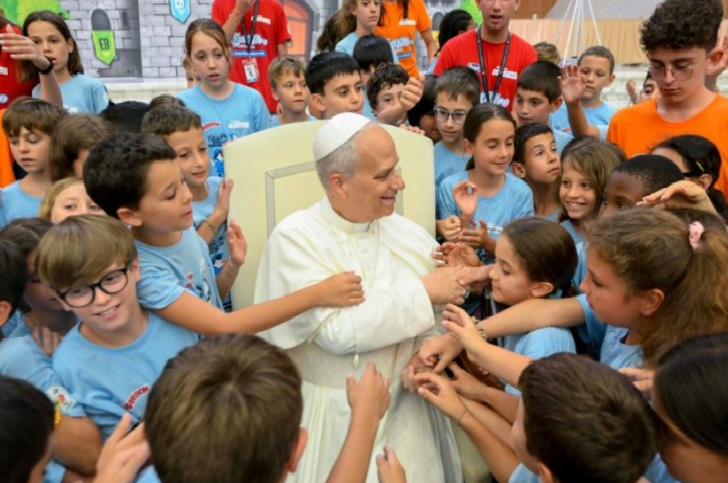
Photo credit: The Azerbaijan State News Agency
Hope lights our way, gives us direction and fills our lives with purpose. Today we reflect on the Mercy Partners value of hope and its vital role in guiding and inspiring our education ministries and the future generations being educated within our schools.
In our education ministries hope is far more than an uplifting sentiment—it is a lived expression of faith, a driving force behind learning, and a steady foundation for belonging, contributing and leading. At a time when young people face increasing complexity, uncertainty, and rapid change, Catholic education offers something profoundly countercultural: a belief that every person is created in the image of God, inherently gifted, and called to help build a better world. As Pope Leo XIV writes in his apostolic letter Drawing New Maps of Hope (27 October 2025, §1.1): “Where educational communities allow themselves to be guided by the word of Christ, they do not retreat but are revitalized; they do not build walls, but bridges.” This conviction shapes not only what students learn, but how they grow, how young people interact with one another and learn to serve and support others , and how communities flourish.
Hope, in the Catholic tradition, is always active. It is not naïve optimism but a deep trust that transformation is possible. In classrooms, this hope becomes visible through a learning culture that embraces curiosity, courage, and compassion. Teachers encourage students to see beyond limitations—to notice beauty, seek truth, and strive for justice. Students are invited to wrestle with big questions, to learn from mistakes, and to recognise their own capacity for good. Such experiences nurture resilience, confidence, and a sense of purpose that reaches beyond academic achievement.
Shared values give this hope a clear direction. The principles of dignity, solidarity, the common good, and stewardship are not abstract ideas; they are woven into daily school life. They guide how relationships are formed, how conflicts are resolved, how success is celebrated, and how decisions are made. In this environment, hope becomes something students can practise in how they welcome others, care for creation, stand alongside the vulnerable, and contribute to their communities. Our education ministries aim to graduate not only capable learners but compassionate adults who are committed to the common good and have the capacity to contribute positively to the wider community.
Leadership within education ministries draws its strength from the same values. Principals, teachers, and staff are called to lead with integrity, humility, and a deep sense of service. Their leadership is grounded in modelling the kind of hope they wish to ignite in young people. They foster cultures where every individual is respected, where gifts are recognised, and where the wellbeing of all is held at the centre. When leaders embody mercy, justice, and hospitality, they inspire others to do the same.
Our education ministries provide hope for their wider communities. They stand as places where faith and reason are not in competition but in dialogue, where tradition meets innovation, and where young people are equipped to shape a future marked by compassion and courage. In a society often fractured by division or anxiety, these schools offer a reminder that hope is both a promise and a responsibility—something we inherit and something we pass on.
Grounded in shared values that have guided generations our education ministries continue to be a living declaration that the future is bright because our young people carry within them the light of possibility. And when that possibility is nurtured with love, wisdom, and faith, hope does not merely survive—it thrives.
Click here to read inspiring stories that show how hope is flourishing across our education ministries.
